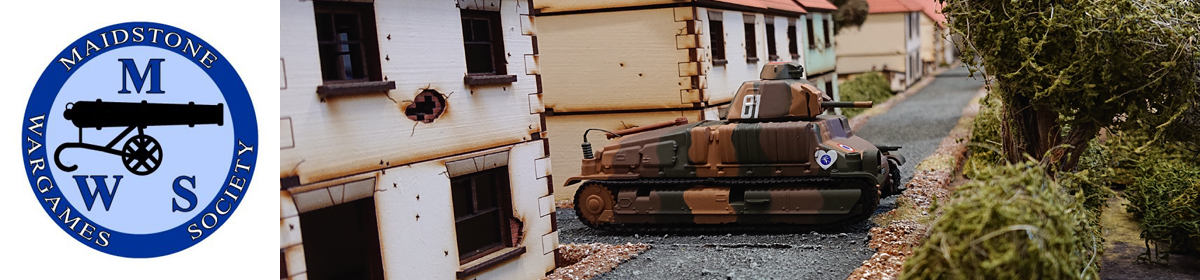
Work in Progress Wednesday

It’s Wednesday again and we have a varied selection for this week.

Above Tony F has dug out some old building models, they are apparently by French model railway manufacturer MKD. I think the plan is to paint them up for some 20mm WW2 action.

Next up John L has made a bit more progess on his Norse Gael Warlord.

Next up Marcus has been painting more planes, this time some ME110’s

And lastly this week, Eric has painted up some Roman Cavalry horses.

and some British Aeronef Destroyers.

See you for next weeks progress.

Work in Progress Wednesday

We start this week with something from me, I now have all 10 napoleonic era balloons painted up. Still need a bit of highlighting to do, next up will be the crews.

Next up John L has some more Norse Gaels on the go (I’m sure this is the second set of Norse Gaels John has painted?).

A new Norse Gael warlord, and below some javelins.

This year’s Christmas game at the club is going to be a tank game, which has inspired Tony F to paint up some tanks. These are FCM-36’s (means nothing to me either).

And finally this week Stephen has built some more medieval scenery. This time some beehives.

See you next Wednesday.

Work in Progress Wednesday

We start this week with Mark J and the stunning progress on his Judge Dredd game. Judging (no pun intended) by these figures the game is going to look very good.

and a close up of the robots.

Next up Eric has finished his Gaulish dog handlers.

and last but not least for this week Stephen has created a well, as scenery for a bit of Saga Crusading.

See you next week.

Wars of the Roses – Battle of Wakefield – Battle Report

The fourth battle in our long standing campaign to re-fight the Wars of the Roses (details can be found on the campaign page) brought us to Wakefield. Going into this battle the Yorkists were 2-1 up but with Wakefield being a historical disaster for the Yorkist cause there was every chance that lead was about to end.

Stephen takes us through the battle from the Lancastrian point of view with additional details from Jeremey for the Yorkists.

Battle of Wakefield
Wakefield was a decisive battle in the Wars of the Roses – Richard of York would be killed, thus blunting the Yorkist pretensions to the crown. Well, it would, wouldn’t it.
It was a very decisive victory for the Lancastrians, whose army greatly outnumbered that of York. Richard of York found himself encamped in and around Sandal castle, just outside Wakefield.

Queen Margaret led the Lancastrian army and as they approached the castle the Duke of York led his men out to meet them in battle. Estimates have the army of York at around 5,000 and the Lancastrians at about 12,000, with the Lancastrians fully surrounding the Yorkists. The inevitable happened.
Arguably, given that situation, it might not make much of a game, so to give the Yorkists a fighting chance we increased the ratio – the Lancastrians had 925 points and the Yorkists had 750.
Turns out they didn’t need them!

Let’s say it right at the beginning – the shame of this one lies on my shoulders. No excuses.

Anyway.
Since the Lancastrians had a numerical superiority we split them up into three commands – myself with the Duke of Somerset and all the cavalry – 4 bases of mounted men-at-arms, 2 bases of currours, and 2 bases of border horsemen. The flanks were split between the Earl of Wiltshire (Andy) and Lord Roos (Tim). Wiltshire and Roos had the same: 1 dismounted men-at-arms, 3 retinue billmen, 4 retinue archers, 2 militia archers.
Jeremey would take sole command of the Yorkists.

Jeremey deployed his troops in a very orderly U shape. I deployed the cavalry in the middle, with Wiltshire and Roos on one flank each. The plan was simple – the classic Zulu battle tactic of the horns of the bull attacking first, followed by the bull’s charge in the middle.

Seeing how surrounded he was, Jeremey immediately tried to re-deploy some of his troops, notably his currours swinging to face Wiltshire with the hope of driving off the archers.
(Jeremey – at the start of the battle I panicked, I was already facing an enemy on three sides and had screwed up my deployment, I started deploying my units as a block decending from the centre line but a quick check of the ambush deployment scenario in Sword and Spear said all of my units had to be closer to the centre line. I hadn’t even put my archers facing the flanks or front! So thinking the battle already lost I thought I might as well see if I could catch out the archers on my right flank by surprise).

I’d strung my cavalry out, directly facing Jeremey’s men-at-arms. Both the Yorkist and Lancastrian mounted men-at-arms are equal in ability, so realising that any contact between the two of us would be a 50/50 chance of winning, and since I had twice as many mounted men-at-arms, I started moving my cavalry into a double line – thinking that if he broke through one line, the chances are he wouldn’t break through the next. I could take the loses, he couldn’t.
(Jeremey – seeing I would be outnumbered if Stephen charged down the middle of the field, especially now that I’d moved some of my cavalry out to the flanks, I tried to move up some infantry units to support the centre).

Out on the flank, the archers moved forward and sure enough engaged Richard’s army. First blood went to the Lancastrians!
Jeremey continued to sort out his deployment, realising (quite naturally) that he had multiple fronts to deal with. He seemed to have a few commanders in the army, which would help since an attached commander means a unit can manoeuvre with a lower activation dice. It still looked very messy in the ranks of Richard’s army.
(Jeremey – It was a mess, I wasn’t getting the activation dice I needed and my initial deployment was looking like a fatal mistake. I had a general and two captains and started attatching them to units to reduce the activation score needed to get my units moving).

Wiltshire and Roos seemed to be falling into the trap of giving too much attention to those units engaged, and not enough attention to moving up their second line. I think there’s a good reason for that, and I’ll address that at the end. This could prove crucial, because at some point the Yorkists would have to charge the Lancastrian archers rather than just take the arrows, and without that crucial second line of billmen, the archers could suffer.

That said, at this point, it wasn’t looking too bad. I felt confident of a victory – we had the numbers and the position.
(Jeremey – my initial cavalry charge out to the flanks did not prove as successful as I’d hoped for, trying up some of my cavalry in a protracted melee. But the fight was also drawing in other Lancastrian units which meant they were not attacking my disorganised flanks).

I think Jeremey could see I was preparing for a cavalry charge. Truth is, I wasn’t. Like I said, our plan was for the flanks to hamstring his army and then the cavalry to charge in. But I think I made them look too threatening. So he swung some archers around who started to shoot at the mounted men-at-arms. It was tempting to launch my charge at that point but, like I say, that wasn’t the plan. So instead I moved up the border horsemen, who were quicker, and perfectly capable of dealing with that threat.
He was obviously unconvinced.
(Jeremey – I honestly didn’t know what Stephen was doing, my greatest fear was facing a cavalry charge at the same time as an attack against the flanks. I just didn’t have the units to cope with that).

My first mistake – I’d moved my cavalry just within charge range. I didn’t mean to do that. So on his turn he decided to take matters into his own hands and, with the impact bonus, launched his mounted men-at-arms at mine. Can’t say I blame him.
I was secretly happy about that – let’s get it over with sooner than later, I thought. I was fairly confident my multiple lines would stop him and if he lost his mounted men-at-arms then that would probably be it for the rest of his army, having lost their back bone.
(Jeremey – this was my first lucky break in the battle, with Stephen’s command divided into three it meant his cavalry were often left with few activation dice being drawn compared to mine. As such I found myself facing his cavalry without any activation dice. So I loaded up my cavalry with dice and charged).

Now, at this point it’s worth saying that I truly don’t think I’d done too much wrong with the Lancastrian tactics. Yeah there’s always one or two things that could have gone better. But, as any commander will tell you, no military plan lasts longer than the first contact with the enemy.
There was one other, very important, factor to this game. Jeremey seemed incapable of rolling anything other than 6s. He could roll four dice and three of them would come up 6 with the other one a 5 or 4. No matter how good the plans, how many troops you have, it’s hard to fight against that. That’s not an excuse (like I said at the start – I take responsibility for what happened, and I will address that at the end), but it is a simple fact that I am sure Jeremey will be gracious enough to admit.
(Jeremey – to be fair I did have a good dice game, but I wasn’t having it all my own way. After all my initial cavalry charge against the archers failed, I had suffered the lost of most of my own archers at this point and if I hadn’t retreated some of my billmen units I’d have lost those as well.  Part of what led to the idea I was getting lucky with the dice was due to the destruction of Stephen’s cavalry. But when you consider I was able to place activation dice on my units giving them a bonus, plus getting the charge in first and against enemy units with no activation dice. The result was truly in my favour).

So, the cavalry charge.
It didn’t go well for the Lancastrians.
He hammered through the first line, pulverised the second line, and was finally stopped (somehow) by the third line. Although on the next turn the third line would also go!
There, I’ve said it.
The entire Lancastrian cavalry wing destroyed, without taking any of the enemy with it. Even as I type this I’m still not sure how that happened. Two units of Yorkist mounted men-at-arms, took out 8 units of Lancastrian cavalry, without loss.
Such are the fortunes of war and the stories that history is made of.
(Jeremey – see my above point. Having played a fair number of games of Sword and Spear, the golden rule is to get your cavalry charge in first. Preferably with a bonus dice as well. My cavalry charge was as good as it could have been in game terms). 

So let’s turn to the flanks, because that was the end of the centre.
Both Roos and Wiltshire continued their pressure. Andy had realised it was time to move up his second line, and put Wiltshire in direct command of them to get them moving. Tim succumbed to the temptation of allowing himself to funnel too many men (and activation dice) into small scraps, so I sent the Duke of Somerset (who had miraculously survived the Yorkist cavalry) over to him to lend some command and control initiative.
(Jeremey – on my flanks I’d lost my archers and so while the cavalry battle raged, I had started to try and consolidate my infantry units. This didn’t work as planned but actually led to a similar situation as the cavalry. Some Lancastrian units got close enough to charge and therefore I again decided to act boldly and charge).

Jeremey had tried to charge Wiltshire’s archers, but Andy had supported his line with billmen and dismounted men-at-arms, and Jeremey’s currours were bounced off (one unit routed and the other ‘re-deploying to the rear’). It was looking strong on Wiltshire’s flank and, so long as no more serious loses were incurred by the Lancastrians, they could still scrounge a slight victory. Then something surprising happened – Jeremey advanced a unit of dismounted men-at-arms against Roos’ militia archers. OK, so that sounds like a good match for York, but the Yorkists had little support for this charge and the militia had other archers, billmen, and men-at-arms, in the immediate area who could help bolster them. Not sure what Jeremey was thinking – was it hubris, was it spontaneity, was it something else? No idea.
(Jeremey – I spent most of this battle just waiting to lose, I was fighting for pride and the chance to give a good account of myself given the points difference, and poor deployment. As it was the lack of coordinated attacks from the Lancastrians gave me the opportunity to take some risky moves).

What did happen is that the militia manage to stop the charge (Jeremey – I thought I was only rolling 6’s?). This would prove vital, because now both sides started funnelling units in to this fight to offer support. What had started as a whimsical charge, a simple fight between two units, promptly escalated into a fight for that wing! With Somerset now lending Roos a hand, Tim managed to push some archers and bills forward, slowing down the Yorkist cavalry that had destroyed the Lancastrian cavalry, from charging into that flank.
(Jeremey – this is the point that the battle started to turn against me. Despite winning the cavalry fight I now needed the activation dice for the melee on the flanks. Which left my surviving cavalry strung out across the battlefield and out of this crucial fight).

With some relief, the Yorkist casualties started mounting up. However, so did the Lancastrians. In fact, the Lancastrians were the first to reach their morale point – an army wide morale roll was needed. But only a turn or two later, this was also the case for the Yorkists.
Over with the Earl of Wiltshire, and Andy could see the Yorkist mounted men-at-arms making their way over to him, so he started to straighten his lines, ready for a charge.
(Jeremey – I’d managed to recall some of my cavalry and the battle had reached the end stages. Despite their loses the Lancastrians still outnumbered me and so I decided I’d done enough to leave with my pride intact. As a last gesture I tried another charge but this time I was checked by my opponent).

Meanwhile, over on the other flank, the fight between the Yorkists and Roos’ men reached a climax – a unit of Lancastrian bills charged into the flanks of the Yorkists, finally routing them. This had been a desperate fight indeed and the loses that Richard of York’s army took helped prevent a humiliating Lancastrian defeat.

It was now more or less over. On the same turn both sides had reached their broken level.
We sat back and it was declared a draw!
Well, a tactical draw it may have been, but in reality it was an overwhelming moral victory for the Yorkists.

So what went wrong?
Two things really.
Firstly, Jeremey was doing some cracking dice rolling. There’s not much anyone can do about that. It’s simply the case that he was just rolling 6s all the time, and we weren’t!
(Jeremey – as I’ve mentioned the Yorkist ‘good’ rolls have disguised a fairly even fight in other areas).
Secondly, I must take responsibility for not thinking about command and control. I gave the Lancastrian army just three commanders – three generals. Each command had one general to take full responsibility for command and control. Now, that was actually adequate for the cavalry, the smallest command, and closely deployed in supported lines. But the two flanks would be more strung out, meaning it was hard to keep them all in command range (actually, both flanks often had troops out of command). This made it difficult (nigh on impossible) for the Lancastrian flanks to keep their second line of billmen up with the archers to respond to any Yorkist charges. Ideally, each flank needed two commanders – a general and captain. This would have meant the Lancastrian battleline would have been stronger to repel Yorkist charges, meaning fewer loses.
I have to take full responsibility for that. Any successes the Lancastrian army had to force a draw rather than utter defeat are to the credit of Andy and Tim, not me.

Anyway, a draw it was.
(Jeremey – I was expecting an early bath on this one. My initial deployment stiffled any attempt to take the battle to the enemy. Archers in the wrong place, slow moving infantry stuck in the middle and an initial cavalry charge that went no where. But the Lancastrians just didn’t press the attacks on the flanks. Maybe by splitting their command into three meant each commander was trying to preserve their own small force? Whatever the reason I’m glad I didn’t look a gift horse in the mouth and took some very bold moves and effectively won a draw).

Yorkist Loses
4 Units of Longbows (12 points)
2 Units of Militia Longbows (6 points)
3 Units of Billmen (12 points)
3 Units of Currours (12 points)
Total loses 42 points (Army break point 39)

Lancastrian Loses
4 Units of mounted men-at-arms (16 points)
2 Units of currours (8 points)
2 Units of border horsemen (6 points)
1 Unit of dismounted men-at-arms (4 points)
3 Units of retinue archers (9 points)
3 Units of militia archers (9 points)
Total loses 52 points (Army break point 49)

Battle Declared a Draw

Work in Progress Wednesday

It’s Wednesday again and a few of us have made some progress.

Above Eric has finished his War dogs, while below we have some more Chaos Cultists.

Next up John L has made some more progress on his Italian crossbows.

And lastly for this week I’ve had a test paint of one of my Napoleonic balloons.

See you next Wednesday.

Work in Progress Wednesday

Just a few offerings this week.

Above Mark J has been making some good progress for his upcoming Judge Dredd game. This time we have some civies and below some wonderful coloured vehicles.

Next up John L has continued with his Condotta infantry.

And last for this week Marcus has finished some more terrain for his vietnam air game.

See you next Wednesday.

Work in Progress Wednesday

We had a little break last week but we are back with some more progress.

Above Stephen has been adding to his Elven army with an Elite bodyguard.

Next up Eric has taken a break from painting Mechs and started on a unit of Gaulish War Dogs.

Then we have John L again at the starting point for his Late 14th century Condotta foot.

Marcus has been working on a gaming mat to represent the fields of Vietnam.

And last for this week I’ve started making some river sections.

And also made some more progress putting ropes on my napoleonic balloons.

This aspect has turned out to be quite fiddly so has slowed me down a bit.

See you next week (depending on progrees of course!)


Work in Progress Wednesday

It’s another Wednesday and we have a bumper crop this week.

I’ll start with my progress for a change. The above image shows the progress I’ve made with my Napoleonic Balloon project. I’m building ten balloons in total for the game.

Next up I’ve been painting two more cavalry units for my Wars of the Roses army.

Next we have Marcus with yet more planes. The first batch are A4C’s (whatever those are?)

And some Mig 23’s

Now we have the start of some more Swiss infantry for Felix’s Lion Rampant army.

And lastly some more Dredd miniatures and scenery from Mark J.

That should be an impressive game when it’s finished.

See you next Week for more progress.

Work in Progress Wednesday

This week Eric has been busy making some more scenery for Gaslands. Above we have a good looking Gas Station while below are some rocks.

Stephen has started work on building a 15mm medieval castle. This is intended as a nice backdrop to a Wars of the Roses game to re fight the battle of Wakefield.

And lastly this week Marcus is at it again with yet more aircraft. Firstly a Condor german bomber.

And something a bit more modern with a pair of Tu22M3’s.

See you next Wednesday for more from the members.

Wars of the Roses – Battle of Northampton – Battle Report

This is the third battle report in our long standing campaign to re-fight the Wars of the Roses. Details can be found on the campaign page. Three battles into the campaign it’s become a tradition for the winner to write up the battle report. Which is why Jeremey takes us through the battle of Northampton (spoiler!)

Battle of Northampton
History tells us this was clearly a defensive battle for the Lancastrians, however history also tells us that due to the treachery of Lord Grey the battle apparently only lasted about half an hour. So we dispensed with that aspect and went for the Lancastrians taking up a defensive position. The Lancastrians were allowed enough stakes to cover their front line at no extra costs, but to provide the attackers with a chance this battle was our first game of unequal sides.

Given the Lancastrians static defence Stephen decided to take on full responsibility of command. I as the Yorkists had originally divided up my force to accommodate a guest commander but ended up dividing the army in to three battles to accommodate an additional commander!
Therefore for this battle both Andy and Tim joined my Yorkist forces.  For this battle the Lancastrians had 520 points to the Yorkist 700 and we played using the Sword and Spear 2nd edition rules.

The start of the battle saw the Lancastrians in their defensive position with a front line of archers and two artillery units. Andy took command of the Yorkist left with Tim in the centre, I took the Yorkist right near the abbey.

The first couple of turns were all about the Yorkists getting their units moving. The initiative system in Sword and Spear makes it tricky to get everyone moving at a steady pace. You can do a group move of units but that is still dependent on drawning activation dice from the bag and rolling enough to start the group move. It was soon clear some units were being left behind.

Meanwhile the Lancastrians had little to do but wait for the enemy to come within range of their guns and archers. The Lancastrians also had a camp which would allow them to increase the reach and potency of their missile fire through the Resupply strategy.

I advanced my force at a break neck speed outdistancing my subordinate commanders and setting a fine example of how a real commander should lead. Although a pause was required to allow some of my units to catch up. While I did this Tim also managed to advance in the centre, but Andy had the furthest to travel so was somewhat behind.

Realising you can’t make an omelette without breaking any eggs I advanced my archers within range of the Lancastrians taking the chance that they could withstand a volley (or two!) and return the complement, to try and create some holes in the Lancastrian line.

However it was not to be. Some good dice from Stephen and poor dice from me saw both my archer units wiped out before they could even loose an arrow! This made me pause in my advance fearing that I’d have no chance of reaching the Lancastrians with my slow moving billmen and men at arms.

In the centre Tim decided to just go for it and continued his advance. Stephen thought it was worth trying a few ranging shots, but didn’t quite have the distance.

A turn later and Tim and Stephen were able to exchange fire. Tim’s forward units of billmen and spearmen took a bit of damage from the Lancastrians but in return they managed to destroy some of the Lancastrian guns and open up a hole in their defensive line.

Spurred on by this Tim adavanced his units even further. Unfortunately this proved costly with the spearmen succumbing to more artillery fire. Luckily Tim’s captain attached to the unit survived to be able to support the remaining units in the continued attack.

Tim’s bold advance saw the first of the Yorkists units reach the Lancastrian defences. For Tim this was his dismounted men at arms. Unfortunately Stephen had plugged the gap left by the loss of his artillery with some dismounted men at arms of his own. With a supporting unit for the Lancastrians and their sharp stakes taking away the Yorkist impetus, this turned out to be a tough fight that would last for a few turns.

Being slightly embarrassed by one of my subordinate commanders getting into melee first, I decided I’d spent enough time regrouping and launched an attack with my billmen. I had some rather useless cavalry and so I put them out front as cannon fodder to at least take some of the incoming missile fire away from my heavy infantry.

On the Yorkist left flank Andy had finally got his forces in range and was able to start making holes in the Lancastrian defence thanks to some good archery. This forced Stephen to think about plugging more gaps, but he held off this time fearing Andy could just stand off and continue firing on the defensive line.

Meanwhile in the centre Tim had managed to get a unit of billmen into melee to continue the assault. This added much needed support to his hard pressed men at arms.

Following this change in momentum, and thankfully because I rolled some good activaton dice. I managed to get my men at arms and billmen into melee against the Lancastrian archers. Even with the stakes taking way my impetus, the archers were no match for my heavy infantry. These Lancastrian loses pushed them over their Morale threshold forcing Stephen to make tests for each unit. Unfortunately for the Lancastrians this resulted in the loss of a few more units.

Andy was still causing trouble on the Lancastrian right flank, forcing Stephen to move up his billmen to prepare for an assault from Andy’s infantry.

With the Lancastrian line crumbling and more Yorkists arriving the battle reached a final stage. Although the Yorkists were at this point only one unit away from their own morale test point.

But there was to be no last minute Lancastrian revival, Tim’s billmen broke through the Lancastrian defensive line and engaged a unit of militia archers. The blue dice shown are Tim’s Yorkist scores against Stephens black Lancastrian ones. This lost unit pushed the Lancastrians over their break point with the remainder of the turn seeing enough other Lancatrian loses to make the battlefield look like a resounding Yorkist victory. Truth be told there was a moment it was clearly in the balance.

That leaves the campaign at 2-1 to the Yorkists, but Wakefield is up next.

Yorkist Loses
3 Units of Longbows (9 points)
1 Unit of Spearmen (4 points)
2 Units of Billmen (8 points)
Total loses 21 points (Army break point 35)

Lancastrian Loses
2 Units of Dismounted Men at Arms (8 points)
1 Unit of Billmen (4 points)
5 Units of Longbows (15 points)
4 Units Militia Longbows (12 points)
2 Units of Artillery (4 points)
Total loses 43 points (Army break point 31)

Yorkist Victory