Work in Progress Wednesday

Despite over half of the membership regularly playing historical based games, this weeks progress is dominated by Sci-Fi. We start with Mark J and some more progress on his Legions Imperialis forces.

Next up and Stephen has been mixing various plastic kits to come up with some interesting characters. I think these are destined for a hive of scum and villainy somewhere.

Andy has also made progress with his various projects. The Werewolves have been primed along with a robot.

The Einherjar (space dwarves) have also been primed but Andy is also experimenting with zenithal highlighting.

That’s also been applied to his Sneakfeet (space halflings), will be interesting to see the results.

And last but not least this week, I’ve been painting some more of my 3mm sci-fi miniatures. This time some light mechs, just need to do the basing.

We will see you next week with more progress on our projects.

BATTLEZONE: MWS 2025 Show Game

Stephen takes us through the creation of this year’s retro-futuristic show game.

For 2025 the MWS Show Game is a table-top version of the arcade classic from the early 80s, BATTLEZONE.

This used to be a favourite of mine and I would get through pocketfuls of 10p coins playing this. It featured a stark black landscape with wire-frame graphics. You took control of a tank and manoeuvred around geometric obstacles trying to shoot enemy tanks.

So when we started to think what our show game for 2025 should be I suggested we create a table-top version of Battlezone.

There are a few things to keep in mind for a show game. Yes, it should be playable and quick and easy to pick up. We aim for a game to last about 45 minutes – that gives players a good taster and also means they don’t have to commit too much time and can get back to enjoying the show. We also need to think about transport – getting the game in and out. Ideally it should disassemble so those attending can carry it in and out rather than get stuck in a queue to unload and load. And there’s also cost, especially for games like this which will have components with little use outside of the game.

The good thing about our Battlezone game is that it would tick all these boxes – there’s no intricate scenery or terrain (but what there is, is bespoke for this particular game), as such it all breaks down so it is easy to transport. And with Too Fat Lardies’ ‘What A Tanker’ rules (which we decided we would adapt) many gamers will already be familiar with the concepts behind the rules.

It was obvious that we would not be able to buy the tank models. Back in the day, that would have meant scratch building with plasticard. But in these days of 3D printing it was obvious what was needed. Fortunately, Phil and Tony of Brigade Models are both club members and both are very IT literate with a 3D printer. I’ll leave Tony to explain how they went about this:

Tank 4 (the ‘Brigade’) at design time in Wings3D. As you can see, the basic designs are suitably minimal.

We started by searching the internet for images of the original tanks in the game. Finding images was easy enough, although a bit more work went into finding ones that were directly head on or side on so that the dimensions weren’t too distorted. Eventually I found enough information to draw up the basic outlines of the two tanks that looked about right using a 3D modelling package called Wings3D. I also designed the UFO (which didn’t make it into the final version of our game) and missiles, although we drastically scaled these down from the tank-sized killers that they appear to be in the original. We went through several iterations of the designs with slightly different details until we were all finally happy. We toyed with the idea of making them wireframe models but in the end the consensus decision was that they’d be too fragile on the tabletop. So we went with slab-sided models with the wireframe outline etched into each side to help Stephen with the painting process. The tank hulls were one piece, with the guns printed separately (it made the print process easier). Phil then printed them on our Phrozen 8K resin printer in grey resin and handed them over to Stephen for painting.

Three tanks plus a bunch of missiles arranged in our printer software ready for printing.
The same collection of models coming out of the printer.
And finally, those three tanks after cleaning in isopropyl alcohol.
The basic tank – ‘Atari 1’ – printed, cleaned and ready for painting.

We wanted a four-player game. There were already two tank designs that featured in the original arcade (we designated them Atari 1 and Atari 2). Tony also uncovered an interesting bit of trivia – that the US army used the Battlezone game engine to train drivers for the (then) new Bradley IFV, so that was another natural choice (and we designated that one Bradley). The fourth tank was an original design by Tony, keeping to the Battlezone aesthetic – and this final one we called the Brigade (note from Tony – the basis for the fourth design came from a suitably old 1980 sci-fi book called “Tour of the Universe).

Memory messed with me a little when it came to the missiles. I wasn’t sure the original Battlezone had missiles in it yet at the same time I do remember a tank game that had missiles, just unsure whether it was Battlezone or not.

But what the hell! It’d give an extra dimension to the game so missiles were in! As it turned out there were missiles in the game.

‘Atari 1’ with a coat of satin black and the painstakingly (not to say painfully) applied neon green outline.

Now on to terrain.

There’s not much of it, just pyramids and blocks. We did discuss 3D printing these as well. However, Brigade’s 3D printer was naturally busy with printing items needed for the business. So I decided that I’d purchase some 1.0mm thick plasticard and make them – not the world’s most complicated modelling job! I made squares, pyramids, and rectangles in various sizes to give some variety.

The whole thing about Battlezone is that stark, neon, vector graphic look. This was going to be the main appeal of the game and central to getting it right. Now, on the surface of it this looks like it couldn’t be simpler – spray black and then paint the lines.

And, yes, that is exactly what I did. All the tanks and terrain got a spray of satin black. Nice and easy. And then on to the lining. This was a real ball-buster. What didn’t help is that the lines had to be done twice. I first had to do them in white as an undercoat (the neon wouldn’t take being painted straight on to the black) and then go over that with the neon paint. This got very tiresome. Very, very, VERY tiresome. I don’t want to see neon paint again for a long time.

The simple geometric terrain blocks, true to the original game.

Another important part of the game is the background. The horizon in the game is an endless border of mountains. So it wouldn’t be enough to just plonk the models on a piece of black felt, I also wanted to create that field of distance. There’s also a practical element to it as well, since it defines the gaming area. These borders were made from some decking bought from Wickes with a simple slot to link them together and then painted. I thought about the height – it had to be tall enough so that it looked like a barrier but not so tall that it became a faff to lean over.

A side-on of Atari-1 in the battlezone.

All the game components were complete, all that was left were the rules.

There was obviously only one contender – TFL’s ‘What A Tanker’. Now, this has been used in show games many times already so that was nothing new. One of our club members, Marcus, had created his own sci fi version which he called ‘What a Grav Tanker’. Since this had received some play testing I decided I’d adapt that. Truth be told, the rules we are using are not fully ‘What A Tanker’ but anyone familiar with that will see clearly where the inspiration came from and will immediately click with the logic behind the rules. This is our rough-housed version that is designed for show games that need to last a fixed amount of time.

With the kind permission of TFL, you can download the rules, battleboards and turn cards from the links below:

Rules

Battleboards

Turn Cards

Bradley (l) faces off against Atari-1.

Like all projects, there’s no way this could have been completed on my own. That’s the advantage of being in a club – you have the skills and abilities of gifted club members to help realise your original plan. For that reason I must express my thanks to club members Tony, Phil and Jeremey who all chipped in to help and without whose invaluable talent and knowledge the game could not have made it to the table. Thanks also go to Pete, Andy, and Eric who helped with the playtesting.

Atari-1 has Brigade in its sights.

So this is our club game that we will be bringing to shows in the south east during 2025. Currently we are planning on being at Cavalier (Feb 23rd), Salute (Apr 12th), Broadside (Jun 14th) and RE-Play (Oct 25th) but we could also find ourselves attending other shows in the year. You’d be more than welcome to join us for a game.

Work in Progress Wednesday

Welcome to another work in progress Wednesday. We start this week with Marcus who has been busy basing his 6mm miniatures for a sea based game. Above we have some VTOLs and below a mixture of naval units and hover tanks.

Next up Andy has been prepping a number of miniatures for various projects. Firstly some space dwarves.

Some halflings (called Sneak feet apparently) snipers.

And some werewolves.

Meanwhile Tony has created some turrets on what look like some sea based platforms.

And he’s also been painting up some new roads.

And finally for this week Stephen has painted a useful piece of packaging and created this sci-fi building.

And with that we will see you next week.

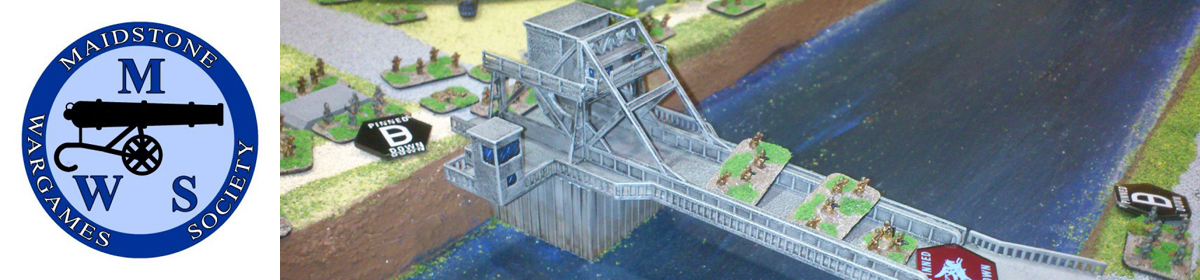
France 1940 – The Bridges – Battle Report

Alan takes us through a big game of Chain of Command set in France 1940.

The purchase of a Cigar Box Battle river mat on eBay sparked thoughts about the interesting challenges of a game with one side having to make a strategic withdrawal across a river and the other trying to seize the crossings.

This led to the purchase of not just one, but two bridges from Sarissa Precision, a road and a rail bridge. The latter then led to building the track to go with it and then a station. To make the game work it needed to be big both physically (a 12 foot by 6 foot table) but also from a Chain of Command perspective; this meant at least a company a side. This was the result.

It saw a rag-tag French outfit as the defender facing a determined German company supported by a platoon of tanks. The French were made up of a platoon of Foreign Legion and a platoon of Tirailleurs Sénégalais on one side of the river, needing to withdraw across the bridges and a Motorcycle platoon holding those bridges. The French also had some support in the form of an anti-tank gun and some engineers in a truck – the latter to demolish the bridges before the Germans could capture them intact. Along with two Bouteilles Incendiaires, two roadblocks and a couple of full Chain of Command dice for the withdrawing troops, this was the defending force. The Germans, in addition to their infantry company and tank platoon, had an Adjutant, a Pioneer team in a Kubelwagen, a SdKfz 222 armoured car, an infantry gun and a truck with four rubber boats. It wouldn’t have been an early war game without a Shabby Nazi Trick – the German players selected a fifth column sniper (Jean-Claude). We played through the patrol phase which saw some interesting jockeying for positions around the buildings on the German side of the board. With jump off points then positioned we were ready for the meat of the game.

The Foreign Legion were covering the French left flank and the Tirailleurs Sénégalais on the right. The Germans began their advance with the platoon on their right flank making serious progress until they encountered the Legion. The other German platoons soon found that the Tirailleurs weren’t going to be easily dislodged and put them under heavy concentrated fire. The roadblock constrained the easiest route for their Panzers and so the main armoured advance was through the farmland to the right of the road.

Repeated exchanges of fire were telling on the French forces as they tried to hold the Germans long enough for their engineers to deploy and mine the bridges.

Eventually they began to fall back but not before taking serious casualties. Meanwhile Jean-Claude who had been placed in the church tower (it’s traditional!) was causing the French some unexpected problems.

With the French C-in-C desperate to blow the now mined bridges he ordered a full withdrawal but this was easier said than done with the Germans covering most of the routes to the bridges.

The Tirailleurs were aiming for the road bridge but when they got there the C-in-C ordered them to switch to the distant rail bridge so he could blow the former.

Meanwhile the German pioneers were making heavy weather of destroying the roadblock and the motorised elements of the German force were still held up as a result.

In the end only a single Legion section got to safety before the second bridge was blown and with neither side having been able to meet their victory conditions we declared the game a draw.

Work in Progress Wednesday

Giant stompy Titan kicks us off this week. Felix has been painting up a Reaver Titan for Legions Imperialis. While Mark J has continued work on a Marauder flyer.

Next up and Tony has started a new project, this time 10mm Dwarves for Lord of the Rings.

And another member for his Stargrave crew.

And finally for this week Stephen has been painting more town characters. This time the silent stranger and Daisy Chainsaw (don’t ask).

And an idol that members will soon be fighting over in an upcoming game of Stargrave.

See you next week.

Work in Progress Wednesday

It’s Wednesday and the members have made a start of their various projects.
First up we have Stephen who has painted a 15mm patrol boat for Vietnam.

Staying with boats and Marcus has also been painting boats, this time some 6mm sci-fi craft

He has also been finishing some 6mm sci-fi hover tanks.

Next up we have Mark J and some progress on his Legions Imperialis miniatures and buildings.

Some Legions Imperialis tanks, super heavy tanks and a gunship

Meanwhile Tony F has been busy getting terrain ready for a Lord of the Rings game.

And as his opponent in the game Phil has been painting some Ring Wraiths to pursue those pesky Hobbits.

We’ll see you next week for some more progress.

History of the Society

2021 was the 50th anniversary of the society and we decided we should have a properly documented history of Maidstone Wargames Society. It’s taken a bit longer than we anticipated but we have finally managed to reconstruct the main highlights of the society from 1971 to the present day.

We’ve given our history its own page and we will add to it each year details of our show games, open days and other events of significance.

History of Maidstone Wargames Society


Work in Progress Wednesday – Christmas Special

While the society members ramp up their projects for 2025 we thought for this Wednesday we would have a round up of the hobby related gifts members received as a teaser of what to expect to see this year.

We start with Phil and a fresh supply of GW Agrax Earthshade and Nuln Oil. If these ever go out of production Phil will never paint again!

Next up and Marcus has some new Battletech miniatures as well as some John Carter of Mars figures. Marcus has recently been painting up 6mm sci-fi forces and clearly felt the need for something a bit heavier.

Now we have Tony F with some Mantic sci-fi terrain, which he says will be appearing in a game of Stargrave this year. He’s also got more reference material for Middle Earth to help with the campaign currently running.

We have some 40k and paint for Charlotte, and some intriguing diorama lights. Never come across those before so am really interested in how Charlotte is going to use them, as intended or as terrain features?

Mark J has just gone for more reinforcements for his WW2 collection. This time some US Airborne troops.

Mark K has a new ruleset to try out in the form of L’Art De La Guerre,

and some Desert Rats decals, so a real mix of periods there.

While Mark W (yes we have a lot of Marks) has the Arkham Horror card game, Dunwich Legacy and the Investigators. You can never go wrong with a bit of Cthulhu style horror in my book (and we all know what book that is).

We have more new rules now, looks like John La will be up for more naval action this year, we’ve seed WW2 and Ancient naval games from John. I can’t remember if we’ve seen any age of sail yet.

Now on to what I got from Father Christmas, I love reading older sci-fi stories and picked this set of three books of edited collections about power armour, super tanks and space fighters. I get a lot of inspiration from books like these for miniature sculpting and rule writing.

And we end our Christmas special with a typical gamer response from Stephen. He didn’t ask for any hobby stuff this year but one of his presents had this packaging, which is being painted up as a sci-fi building as we speak, so look out for that next Wednesday.

That’s it for this week, we hope you also got some nice hobby goodies over the break. See you next Wednesday when our normal look at the work in progress will resume.

Battle at Blavatsky Station – August 1944 – Battle Report

Society member Stephen kicks of our posts for 2025 with a WW2 game of Crossfire.

During the Festive period I decided to have a non-Festive WW2 game using Crossfire rules.

It was a late-war Eastern Front game with the Russians on the attack. Each side had a company which comprised three platoons with a company HQ and machine gun. In addition, since the Russians were attacking, I gave the Russians an extra SMG platoon. I made these veterans (an NKVD unit, no doubt) and decided this platoon’s command bonus would help in both close combat as well as morale (obviously led by a commissar – usually Russian commanders only assist in close combat). Since it was a late-war game, to reflect the change in training and doctrine the Russian army went through, I also decided that Russian squads could end movement out of line of sight of platoon commanders but still had to start movement within LOS as usual (normally, Russian squads have to start and end movement in LOS). This reflects the Russian adoption of the British and American structure they went through when the Russian army went on the attack.

The battlefield was set up as follows:

The Germans deployed on table with all units deployed north of the east/west road. The two large barns and the railway station were big enough to accommodate three squads. The other houses and the chapel could only accommodate two squads.

The Germans put their first platoon in the easternmost barn. In the house looking south down the road was the German company command and machine gun – this would make it very risky for any Russian squad trying to cross that road. In the big barn in the middle went the second German platoon. The final German platoon deployed with one squad in the chapel and a squad in each of the wooded areas either side.

The Russians would deploy by activating from the southern edge.

Each side would gain 1 Victory Point for each enemy squad/machine gun killed. The first to 7 VP would be declared winner.

This was obviously going to be a difficult job for the Russians. The sides were more or less equal (Russians with four platoons and the Germans with three) but the Germans had the advantage of being in defence and set up in protective cover.

Right then, on with the game.

The Russians started activation by bringing on their first platoon and occupying the sunken ground on the extreme left. Second platoon came on and took position in the adjacent woods, and the third platoon came on and took cover behind the fence that ran alongside the wheat field. The plan was for the Russians to attack on one flank where they could concentrate their firepower and force the Germans to break cover or risk being rolled up. The Russians held the NKVD sub-machine gun platoon and the company HQ with HMG back – these were due to deploy on the right.

Initiative still lay with the Russians and so the platoon in the sunken ground made a group move to advance across the rail track and into the woods in front of them. At this point the Germans opened up with Reactive Fire. Using a coordinated crossfire, the German first platoon in the woods and chapel let rip – a series of Pinned results ensued but no Suppression, so the Russians maintained initiative. The Russian platoon decided to return the favour – they Pinned the German squad in the woods on the left but also failed to cause a Suppression. This meant they lost initiative and it switched to the Germans.

With all the action taking place on the western side of the battlefield the Germans decided to advance one of their platoons: those on the right, in the other barn, crossed the road and rail track and took up position in the woods. The German first platoon chose to keep up the pressure and poured more fire on the Russians in the woods. They caused a Suppression, so carried on firing, hoping for a kill on the Russians. But they failed to cause another Suppression which meant the initiative switched to the Russians.

The Russians did two things. Firstly, they brought on the NKVD platoon, which came on at the extreme right in the sunken ground there. They also decided to advance their third platoon across the wheatfield into cover behind the fence overlooking the rail track. At this point the German second platoon, in the barn opposite, engaged them with Reactive Fire. Not only that, but the machine gun also had line of sight and fire arc to the Russians in the field. This would be a lot of Reactive Fire. The machine gun was firing independently and fortunately scored a Suppression, meaning the Germans could carry on. The Germans in the barn shot as a firegroup but only caused Pinned results and so initiative went back to the Russians. But the Russian platoon had taken a lot of fire and all squads were either Pinned or Suppressed.

Both Russian platoons that had advanced found themselves with their heads down – all Pinned and Suppressed. So the Russians needed to start putting the pressure on elsewhere. They did this by bringing on the company HQ and machine gun. These took position on the edge of the fence by the farm. The German platoon in the woods on the right had line of sight and took Reactive Fire, but failed to score even a Pinned result – squads failing to score at least a Pin are marked No Fire (NF) and are unable to conduct any more Reactive Fire during that initiative. This gave the NKVD squad a chance – since they would receive no Reactive Fire they could charge forward and try to engage the German platoon in close combat! Being SMG armed and veterans would give them a bonus. So that is what they did. And it paid off very well indeed – the NKVD over-ran and eliminated the German platoon!

The Russian Company Command and machine gun moved into the first of the farm buildings. What they needed to do next, though, was try to rally some of their squads. However, failing a rally roll also means initiative is lost. As it happened the platoon in the wheatfield managed to rally all its squads, whilst the platoon in the woods on the left managed to rally one squad but failed the others. So initiative once more went over to the Germans.

The loss of the German platoon to the SMG platoon really blunted the German options. The other two platoons had little choice but to dig in and see what they could do. As such, both platoons were organised into firegroups and crossfires to make the most of what they had. The Germans in the barn once again Suppressed the Russians in the wheat field but the platoon in the woods and chapel could only cause Pins on the Russians in the wood so they lost initiative.

The Russian second platoon which, up to now, had remained ensconced in the woods behind the railway station were given the order to move up – by bringing the whole Russian company into line it would spread the German fire. As a group they moved into the railway station and took Reactive Fire from the Germans in front of them – the Germans causing Pins on each of the Russian squads!

Now, by causing a Pin a squad may continue Reactive Fire, but should they fail to cause a Pin then they may no longer do Reactive Fire during that initiative. So the Germans could carry on with their Reactive Fire, hoping to Suppress and steal initiative. But they’d seen what could happen if they get a No Fire marker and are charged. So rather than continue Reactive Fire they chose to hold back and allow the Russians to continue with their activations and maybe another opportunity to react may present itself.

The Russian company command and machine gun chose to move up to the next farm building which brought them directly opposite the German company command and machine gun. And these decided to do Reactive Fire against the Russians – causing a Suppression and taking initiative away from the Russians! So the German machine gun kept on chattering away, this time turning to the NKVD platoon in the woods in front of them – a kill! One of the NKVD squads was off. The Germans decided to make the most of their firing so the platoon in the barn resumed fire against the Russians in the wheat field – another kill!

Things were starting to improve for the Germans.

But not for much longer – they attempted more fire against the Russians in the station but failed. Initiative went back to the Russians. There then followed an extended exchange of fire between the Russian and German machine guns – one side would fire, fail and initiative would switch, and this went on for several rounds, changing initiative after just a single activation. This ended up inconclusive. Occasionally one side or the other would be Pinned or Suppressed, but then rally this off and resume firing.

Something needed to be done.

Then during one activation the Russians Suppressed the German machine gun and decided to advance the NKVD platoon into the barn on the opposite side of the road on the right. But as they moved into the open crossing the road the German squads further down opened up with Reactive Fire. Being in the open was never going to go down well and one of the NKVD squads was killed and the other Suppressed! The Germans took initiative, rallied their machine gun, which opened fire on the Russian machine gun and…eliminated it!

Victory Points were now equal – 3 each. If the Russians were going to win they would have to think of something daring. For the time being, though, it was still with the Germans who continued with their fire against the Russians in the station, but a failure to Suppress soon meant it went back to the Russians.

Close Combat is very decisive in Crossfire – a simple win means the opposing squad/s are destroyed. So the Russians looked to bring things to close combat since they had advantage of numbers on the left. The Russian platoon in the woods on the left opened up on the solitary squad beside the chapel, causing a Suppression. With that, they decided to go for it and charged across the road with guns blazing.

As soon as they broke cover the Germans in the chapel opened up with Reactive Fire. They scored a Pin against the first squad meaning they could carry on, but failing to score any more hits meant they received a No Fire marker and the other two Russian squads charged the Germans with the inevitable result – one dead German squad. With their blood up, and a No Fire marker on the Germans in the chapel, they kept up the momentum and sought to charge the squad in the chapel. However, they could only get one squad against them (remember, the chapel has a capacity of two squads and there was already a German squad in there), which meant it was an even combat and on the dice roll. Which favoured the Russians! Another German squad gone.

The remaining German squad of this platoon, in the woods to the right of the chapel, used Reactive Fire on the Russian attackers and scored a Suppression. With initiative, what could the Germans do? Truth be told, they didn’t have many options. The machine gun opened up on the Suppressed NKVD squad and killed it. Victory Points were now 5 to the Russians and 5 to the Germans – still tight. The German machine gun then turned its attention to the Russian company command but failed to score a hit.

So what could the Russians do? They decided to see if they could Suppress the Germans in the barn. They did even better than that and killed one squad. With a platoon in the railway station and another moving up through the woods and chapel, they decided to bring things to a close. The platoon in the station opened up at the German squad in the woods and caused a Suppression – this was what they wanted and made a charge against the Germans. The platoon in the station fixed bayonets and moved out. They drew Reactive Fire from the Germans in the barn and found themselves Pinned down by the roadside! So the Russian squad in the chapel, under cover of the woods, made a final charge against the Suppressed German squad.

And that was that. The German squad was killed which meant the Russians had reached their Victory Points – 7 German squads eliminated.

It had been a very close game and a very enjoyable one, and the Russians had won.

Work in Progress Wednesday – the Best of 2024 – Part 2

As soon as we posted the best of our Work in Progress posts for 2024, we realised there were many more contributions from the members. We therefore decided a part 2 was required to end 2024.

We start with the contributions from Felix. Felix hasn’t been painting miniatures long but has been getting through a number of projects. Above we have some Ashigaru, but as we’ve seen this year Felix has bounced across various periods.

Here we have the start of his cold war Brits, a Chieftain stands ready for it’s camo paint surrounded by a British Infantry squad.

Jumping back a few years and here we have some of the WW2 miniatures Felix has painted this year. This time some German Volksgrenadier’s.

Next up is a special shout out to member Mike L for his first contribution to the WIP posts. These are a set of miniatures for a Dragonlance RPG game coming to the society. 2024 saw more RPG’s played from D&D to Call of Cthulhu.

Moving on to the Napoleonic era and the current passion of member David P. David has spent 2024 adding a vast number of miniatures to his Russian and French armies.

He has also run a number of games to test out his own rules, with plenty of members volunteering to help with the playtests.

We finish this second part of our WIP review with Eric who also covered a number of genres with his efforts in 2024. Above we see one of the many Gaslands vehicles Eric painted.

There were also a number of Necrons encountered in a game of Stargrave that Eric ran. These were perfect as random encounters in the game.

And out of left field (no pun intended) Eric presented these colourful Dreadball miniatures. I definitely need to practice painting yellow as Eric has done such a good job on these.

And that’s where we are going to leave 2024. Join us in 2025 for more painting and building from the members.