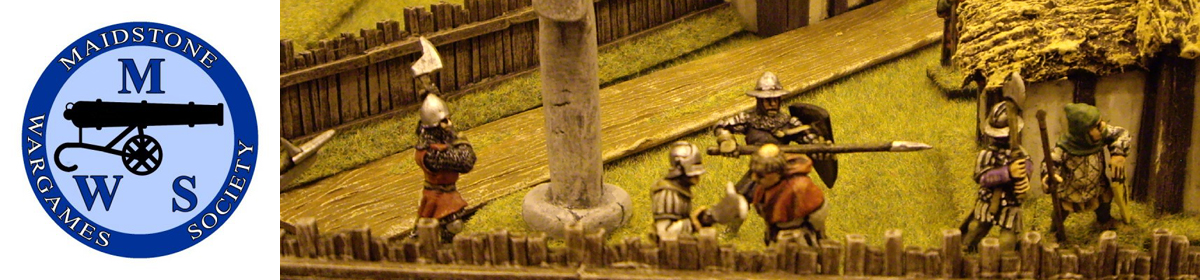

Stephen and Andy report on a comparison of two Medieval rulesets.
We decided to try fighting the same scenario with two sets of Medieval Wargames rules, Lion Rampant 2nd edition and Baron’s War 2nd edition. We would keep the armies as similar as possible in the two games, subject to the requirements of the respective rules.
We based our scenario on the Baron’s War scenario 10 Hidden Treasures and Lion Rampant Scenario 12 The Taxman Cometh.
In Hidden Treasures the players take turns to place six objectives on the table, if a player has a unit in contact with an objective at the start of the turn, they roll a D6, on a 6 that objective is revealed to be the treasure and the other objectives are removed. Who ever controls the treasure at the end of the fifth turn wins the game.
For the Lion Rampant version, we kept the same number of objectives and score to reveal the treasure, but in keeping with the Lion Rampant Glory system we decided that if the player controlling the treasure took the treasure off table he would receive 5 Glory, but only 3 Glory if the treasure was under his control but still on table at the end of the game, plus or minus Glory from Boasts.
We set the terrain up with a small village in the centre of the table, with a couple of fenced fields nearby, with some hills and woods on the flanks. We would keep the same terrain for both games.
Lion Rampant
First off Andy describes the Lion Rampant game.
Andy’s warband comprised:
-
- 1 x Elite Cavalry, Motivated (with Commanding trait) @ 7 points
- 1 x Heavy Cavalry @ 4 points
- 1 x Heavy Infantry @ 4 points
- 1 x Light Infantry @ 3 points
- 1 x Crossbows @ 4 points
- 1 x Skirmishers @ 2 points
Stephen’s warband comprised:
-
- 1 x Elite cavalry with leader (with Commanding trait) @ 6 points
- 1 x Flemish Heavy Infantry @ 4 points
- 2 x Skirmishers with bows @ 4 points
- 1 x Genoese Crossbows with pavises @ 6 points
- 1 x German mercenaries (Warriors) @ 4 points
Stephen won the die roll to determine Attacker / Defender and took on the nominal Attacker roll, the deployment mechanism we used was that the defender deployed any 1- or 2-point units, followed by the attacker doing the same, then repeating the sequence for 3- or 4-point units and finally units costing 5 or more units. The end of the game would be determined b either one player getting the treasure off table, or once there were five or fewer units on the table a die roll at the start of each turn of less than the number of units left on table.
Turn 1. Stephen got off to a good start, advancing all his units except his Elite cavalry, I responded by advancing my Heavy Cavalry to contact one of the objectives but ground to a halt when my Heavy Infantry refused to move.
Turn 2. Stephen continued his advance on the objectives, with one of his Skirmisher units on his left flank contacting one of the objectives. I rolled for the objective my Heavy Cavalry had contacted last turn, with no success, so decided to move my Heavy Cavalry on towards Stephen’s Skirmishers and their objective. I then moved my Heavy Foot towards the first objective, and my other units towards other objectives.
Turn 3. Stephen’s Skirmishers rolled for the objective they had contacted and it came up a 6 the treasure had been found! At this point all the other objectives were removed. Stephen immediately pulled his Skirmishers back and started to move his other units towards his left flank. My Heavy Cavalry were just about close enough to Stephen’s skirmishers with the treasure that I could try to charge them, hoping they would fail their probable Evade reaction. Unfortunately for me Stephen succeeded in evading, his archery taking out one of my riders, and his evade move took him just too far away for me to contact him, my Cavalry then failed their courage test and fell back. To add insult to injury, my next activation to shoot with my Skirmishers at his Elite Cavalry failed, ending my turn.
Turn 4. Stephen continued to pull his treasure carrying Skirmishers back towards his table edge, while he brought his Elite Cavalry across to cover them, and advanced his Heavy Foot through the central village towards my Light Foot. This time I managed to activate all my units, rallying my Heavy Cavalry, putting my Light Foot into Wall of Spears anticipating an attack by Stephen’s Heavy Foot, advancing my Crossbows down the side of the village hoping to be able to shoot at his Elite Cavalry in a later turn, and moving my Elite Cavalry towards my right flank.

Turn 5, Stephen continued to pull back his Skirmishers with the treasure, with his Elite Cavalry getting closer to support them, as were Stephen’s Crossbows. I advanced my Heavy Cavalry towards his Skirmishers, and my Elite Cavalry through one of the fields, but my Crossbows failed in their shooting attempt.
Turn 6 was short, Stephen’s Crossbows and my Heavy Cavalry both failing their activation attempts.
Turn 7 saw Stephen issue a challenge to my Leader, a duel must be fought! Had I refused the challenge all my units would have had to take a courage test due to my Leader’s cowardice. Honour would not allow that, so forth my Leader went. The Duel consisted of three dice each, scoring hits on a 5 or 6, if one Leader scores more hits than the other the loser dies! The duel was anticlimactic, one hit each resulting in a draw, both leaders returned to their units, their honour upheld. Stephen’s German Mercenaries charge my Skirmishers on my left, the Skirmishers evaded, causing a casualty on the Germans, and ending up too far away to be contacted. The Germans passed their courage test, but on my subsequent turn my Skirmishers shot again, causing two more casualties and a courage test which the Germans promptly failed catastrophically, causing them to rout from the field. My Heavy Cavalry charged Stephen’s Crossbows, I won the ensuing melee and the Crossbows failed their courage test becoming battered.
Turn 8 saw Stephen’s Crossbowmen fail their Rally test, but he then went on the offensive, his Heavy Infantry charged my Light Infantry, beating my lighter troops, who then failed their courage test becoming battered

Stephen’s Knights then charged my Heavy Cavalry with the fight again going in Stephen’s favour and my Cavalry failing their courage tests and also becoming battered.

On my turn both my Heavy Cavalry and Light Infantry failed their Rally tests, the Heavy Cavalry so badly that they fled the field.
Turn 9, Stephen rallied his crossbowmen and got the Treasure bearers off table, ending the game.
So, on to the accounting, Stephen received 5 Glory for getting the treasure off the field of battle, he also succeeded in all three boasts he made:
-
- “They shall tremble before me”, 2 of my units battered at the same time, worth 2 Glory.
- “I shall drive them back into the sea”, make one unit retreat off table, worth 1 Glory.
- “I shall challenge their leader to a duel”, self-explanatory, worth 1 Glory.
On the other hands, I made two boasts, both of which I failed to achieve, so scoring -1 Glory each:
-
- “They shall tremble before me”, see above.
- “I shall destroy more units than I lose”, worth 2 Glory.
Final scores: Stephen 9 Glory, Andy -2 Glory. A decisive victory to Stephen.
Apologies for the lack of photos of this game, I got too tied up in fighting the battle to take pictures.
Baron’s War
Stephen takes over with the account of the Baron’s War game.
We put our retinues together to mirror the Lion Rampant equivalents, but under the army composition rules of Barons’ War – so not identical, but as good as.
Stephen’s Retinue:
Unit: 1 x Veteran Lord Commander (mounted), 5 x Regular Knights (mounted)
Unit: 1 x Veteran Serjeant Commander, 5 x Regular Serjeants
Unit: 1 x Veteran Serjeant Commander, 5 x Regular Serjeants
Unit: 6 x Veteran Bowmen
Unit: 10 x Green Crossbows
Andy’s Retinue:
Unit: 1 x Veteran Lord Commander (mounted), 3 x Regular Knights (mounted)
Unit: 1 x Veteran Serjeant Commander, 5 x Regular Spearmen
Unit: 4 x Regular Mounted Sergeants
Unit: 6 x Regular Crossbowmen
Unit: 5 x Green Spearmen
Unit: 5 x Green Spearmen
Unit: 6 x Green Bowmen
So, same scenario – find the hidden treasure and get off with it.
The main point of these games was to compare the rules. For Barons’ War a unit has one activation, but that can be improved to two, or maybe three, if you have a commander attached to the unit (and a commander can also give extra orders to other units). And in Baron’s War players alternate activation of units. This means there is a fundamental tactical difference between the rules – in Lion Rampant you are thinking about what you are going to do now. That’s also the case in Barons’ War (BW for short), but in BW you are also thinking about what your opponent is going to do in the same round, so you have to think about which unit is best to activate, whether to hold activations back for later (in BW your can do a reaction to your opponent’s action), and how the round will develop so you can exploit it. It’s a bit like Saga in that respect – knowing when to unleash everything and when to hold something back for later.

Anyway, let’s get on with the game.
We rolled for deployment, as per BW rules. Andy was the ‘red’ side and could deploy in the middle, which he did and meant he was already in control of a couple of objective markers.


I had the flanks to deploy on, not quite in control of any objectives, but no more than a move away.

Turn one, and Andy searched the objectives, but no hidden treasure was found. My veteran archers on a small rise took aim and let fly at a group of mounted serjeants – two went down to the deadly fire and first blood went to me.

Andy then passed a couple of activations, so I took advantage of this to move units up to take control of a pair of objectives. My crossbowmen (only inexperienced green troops – in BW at least 10% of your army has to be made up of green troops) let rip at Andy’s archers hiding beside a pig-pen. Two were taken down, he failed his morale check and they were broken. However, Andy then returned the gesture, fired back with his crossbows, and three of my troops went down and were also broken. Oh well, eh?
On the second turn my spearmen on the left searched the objective marker and lo and behold, what do they find – treasure! Yup, more church vestments. Funnily enough, the treasure in the Lion Rampant game was found in more or less the exact same spot!
The chase was now on. On Turn three I started to move my spearmen toward the table edge. And this is where the tactical nature of BW may have a slight edge over Lion Rampant, because at the start of the turn both sides roll for initiative to see who goes first. But also (and like Lion Rampant) you have to do compulsory morale checks before moving on to ‘new’ activations. Which means you can’t necessarily guarantee you will move those troops you need to move before your opponent. This builds in tension, tactics, and what makes for an exciting game. In turn three I also did what I think may have been a rash move – my knights charged Andy’s spearmen. Knights do though, eh? That’s why they’re knights. OK, so I demolished and shocked his infantry, but I’d also put myself in charge range of his knights and I had no reactions left.

Andy did what he ought to do – his knights charged mine. It did not go how I would have liked. It took a couple of rounds, but my knights eventually succumbed.

This also left the game in balance. Because at the end of turn five (the duration of the scenario) I had achieved the scenario objective – find the hidden treasure and get away with it. However, Andy had also achieved the general game-end criteria – kill your opponent’s commander (and none of your other commanders pass a morale check to take control). So, who won? We’ll have to leave that one to the chroniclers.

Final thoughts. For me, it is hard to choose between the two because they are so different. Lion Rampant is a quick pick-up game that anyone can jump into and get the hang of in just a turn or two. There is a lot of merit in that. BW requires a little bit of pre-planning (working out and putting together a suitable retinue), but it’s also a more tactical game which means it will take longer for a newcomer to pick up and appreciate the subtleties. No, not more complex, but more subtle. Of course, that’s not to say there are no tactics to Lion Rampant (there are!) but Lion Rampant does lack the depth of BW. Personally, I couldn’t choose between the two. Lucky me that I don’t have to. There is a place for both depending on what you are after for a game – sometimes I want that simplicity and quick ‘pick-up’ nature, sometimes I want a more challenging and thoughtful game. Lucky me that I have both on my bookshelf and can choose depending on my whim. If you are interested in medieval wargames then I’d suggest you have them both as well, because I can’t pick one over the other.
Back to Andy for his thoughts on the two rulesets.
I should open by saying I have played Lion Rampant, and other rulesets in the same family, for many years and am very familiar with them, whereas I have only played Baron’s War once or twice before. This may have an impact on my assessment of the two sets of rules. Both sets of rules have a small-ish number of unit types to start with, and both allow you to upgrade / configure units but Baron’s War has more variety in the options you can apply, and a couple of limitations on force composition, a minimum of 10% of your points must be spent on Green troops, and no more than 50% of your force can be used for units with attached commanders. Lion Rampant has fewer, simpler, upgrade options, and no mandatory requirements for force composition.
I would say that Lion Rampant is the easier game to pick up, but Baron’s War can probably give you more variety in force composition. It’s a “horses for courses” kind of situation, and there is room in my gaming calendar for both rulesets.


 As mentioned this was the first straight up fight in the campaign so far. Neither side had the advantage and so the battle was down to each sides order of battle and how it was deployed. For the Yorkists I decided to include a larger number of militia units to effectively add some fodder to the ranks and hopefully keep the army in the field longer. I also reduced the amount of cavalry units, mainly because I also didn’t want to spend too many points on commanders. The Lancastrian order of battle was fairly similar but two factors were different, the Lancastrians were spread thinner and additional points reduced the overall break point of the army. At the point the Lancastrians broke the Yorkists were still half a dozen units away from breaking themselves.


 Seeing how surrounded he was, Jeremey immediately tried to re-deploy some of his troops, notably his currours swinging to face Wiltshire with the hope of driving off the archers.


 That said, at this point, it wasn’t looking too bad. I felt confident of a victory – we had the numbers and the position.

 Now, at this point it’s worth saying that I truly don’t think I’d done too much wrong with the Lancastrian tactics. Yeah there’s always one or two things that could have gone better. But, as any commander will tell you, no military plan lasts longer than the first contact with the enemy.
 So, the cavalry charge.
 Jeremey had tried to charge Wiltshire’s archers, but Andy had supported his line with billmen and dismounted men-at-arms, and Jeremey’s currours were bounced off (one unit routed and the other ‘re-deploying to the rear’). It was looking strong on Wiltshire’s flank and, so long as no more serious loses were incurred by the Lancastrians, they could still scrounge a slight victory. Then something surprising happened – Jeremey advanced a unit of dismounted men-at-arms against Roos’ militia archers. OK, so that sounds like a good match for York, but the Yorkists had little support for this charge and the militia had other archers, billmen, and men-at-arms, in the immediate area who could help bolster them. Not sure what Jeremey was thinking – was it hubris, was it spontaneity, was it something else? No idea.
 With some relief, the Yorkist casualties started mounting up. However, so did the Lancastrians. In fact, the Lancastrians were the first to reach their morale point – an army wide morale roll was needed. But only a turn or two later, this was also the case for the Yorkists.
 It was now more or less over. On the same turn both sides had reached their broken level.


You must be logged in to post a comment.